Page 2 of 5
Posted: Thu Jan 12, 2006 6:39 pm
by Steve Pitts
Hi Steve
You're fishing the popper that same way that we do back home for bass and it will work - just stick at it.
When I said try cranking it back - yes - I meant just that.
Cast it out and wind in any slack line. Give the lure a couple of hard jerks to create a big disturbance, then wind like hell...as fast as you can.
The lure should skip across the surface, just like a small fish fleeing for it's life. Flying fish, needle fish, menhaden and bunker (in fact most baitfish) will act this way when chased by a predator.
If there are any barracuda nearby, say within 50 metres, they will cover the distance and slam your lure hard in mere seconds. You cannot wind too fast and a barracuda will outpace you every time. They have to be the fastest accelerating fish you can catch from the shore and they'll leap about and give you a good scrap (I'll send another picture to Steve of a 15lb cuda caught on a 'cranked' popper in 2 feet of water).
Jacks also like a fast lure retrieve. They aren't as fast, but they are PDQ over a short distance and then they slug it out like a prize fighter. We love 'em.
This method is ideal for covering a lot of ground because you are casting and winding so frequently. Have half a dozen casts and move along the beach a few paces - cast and retrieve a few more times, then a couple more paces. If you don't catch it's because there is probably nothing there at that time, but most of the jacks and tarpon are nomadic, so they may be somewhere else, at another beach perhaps. We've tried three beaches in quick succession sometimes and then found the fish feeding and had some real fun. Feeding birds are always a give away. If the terns are working a beach then that's a good sign. Pelicans are a bit lazy and tend to hang out at the same spots, even if there are no food-fish around - they just wait for the baitfish to come back - they will eventually.
I would love to spend a few months on Tobago to really get to grips with the fishing potential. There is so much to learn and we have only scratched the surface. I think that it is one of the best places to fish for sportfish anywhere in the world! (but let's keep that as a secret between ourselves eh)
Cheers
Steve
Posted: Thu Jan 12, 2006 10:05 pm
by Mandy E
Hi Steve
Thanks once again for some great fishing info . That's some Tarpon by the way , great stuff.Did the weight of the fish make you sink in the sand up to your knees , or were you just kneeling down ?
An interesting piece regarding the speed of retrieve for poppers .
Is a fast retrieve equally affective for Tobys,Yanns , solvkrokens ect ?
The reason I ask, on a recent trip to Ireland I fished a deep rock mark from the shore . I was only able to get Pollock to take by retrieving a Yann as fast as I could possibly wind , slow the speed down and no interest was shown. Speed on that occasion produced fifteen Pollock to nine pound, however I don't find speed a consistent fish producing method in the UK or Ireland . Do you find speed a consistent catcher with metals on Tobago fish ?
regards Laurence
Posted: Thu Jan 12, 2006 10:47 pm
by Stephen Hull
Steve and Laurence
Yes the speed thing is interesting, but obviously works out here. I shall try the "crank" method next time!
On another point, as you know, there's usually a lot of surf at Sandy Point from the waves breaking over the reef. Indeed, most of the shallow beach and rock marks here generally have a fair amount of surf inshore. Do you find poppers catch better in calmer conditions or are the fish smart enough to filter out wave disturbance from that caused by a fleeing baitfish? This has been another factor in me preferring shallow divers to date as I wasn't sure fish would be able to discern poppers amongst the surf.
Inciedentally, if there's any research you want me to do while I'm out here, don't hesitate to ask. I am trying to go fishing 3 or four times a week (mostly early morning) and am generally free to nose around during the daytime as long as I take the children with me.
Steve H
Posted: Fri Jan 13, 2006 1:51 am
by Dan
Steve,
Thanks for the tips, great photos as well. My wife and I will be arriving on the 23 of January and have a month to check out Tobago< Grenada< Bequia. We might end up staying a month in Tobago if it is a s good as this forum has made it sound. If anyone will be there and is inerested in going fishing let me know. I believe we will start at Pigeon Point and work are way north. I have seen two different posts in regards to fly fishing guides. David Williams or Hard Play I believe? We will go on a few guided trips and will be happy to post phots etc. David Willaims seems to be a bit cheaper than the Hard Play? This is one of the friendliest forums I have visited and feel that is a main reason for my wife and I choosing this as our holiday destination.
Thanks again from Alaska
Posted: Fri Jan 13, 2006 8:53 am
by Steve Pitts
Hi Dan
''King'' David Williams is based in Castara and offers what he calls ocean fly fishing to anglers who bring their own gear. I assume that this means fishing for pelagic species like tuna, dolphin (mahi mahi) and tarpon etc.
Frothy De Silva's Hardplay operation runs Hardplay light as an inshore flyfishing charter for tarpon in the main. I don't know if they do any teasing of billfish (marlin, sailfish) from Hardplays 1 and 2, but they may offer this speciality in season. It would be interesting to hear from anyone who has fished from any of the Hardplay fleet recently, or from Frothy himself, on the subject of offshore fly-rodding.
There is a guide who offers wading on friendship flat, but I don't have any contact details. He takes one or two anglers at a time and fishes almost exclusively for bonefish on the fly.
Kester Herbert (mentioned many times before) is an all-rounder who does everything very well - inshore flyfishing for tarpon from a skiff (Grand Slam), as well as bonefish and permit on the flats. Offshore (Grand Slam II) he trolls for pelagics and is without doubt, up there with the other offshore captains, always doing well in the local touraments.
If you are staying in the pigeon point area you must contact Kester and see if he has a spare day or half-day.
Steve - we find poppers will work in heavy seas and surf, but we do fish them in the more traditional fashion e.g pop.......pause...pop..pop............pause etc.
Fish like cudas and jacks (and bass back home) do appear to have the ability to filter out the background noise of a raging surf and identify the splashing of a baitfish / lure and home in on it with ease. I'm convinced that the larger poppers actualy sound similar to predatory fish attacking on the surface and this alerts others that it's feeding time. They then see the lure and hit it, assuming it's something trying to escape.
Poppers will of course work when it's flat calm, but best of all, they rarely, if ever, get hung up. I've still got an Aigle magnet slider that has caught a lot of good fish and it has survived around eight weeks solid fishing in Tobago and Belize. I've changed the hooks a couple of times and it's looking a bit the worse for wear now, but it's certainly good for another trip or two.
Laurence - we do use Tobys and other metal lures, but only when the water is considered deep enough. Because of the shallow water and reef structures, you'll loose lure after lure, unless you wind like hell and that's how we found that barracuda and jacks like a fast retrieve.
We then tried 'the crank' with surface plugs and found the ideal solution - you don't loose poppers / sliders in the rocks like you loose Tobys and the fish tend to stay hooked (Tobys tend to get flung around as fish shake their heads and the hooks work loose). We only use Tobys if we need either depth or distance and that's rare, as most of the predators will be near the surface (especially at dawn) and often quite close in, if they are blitzing baitfish.
Got to get to work now
Cheers
Steve
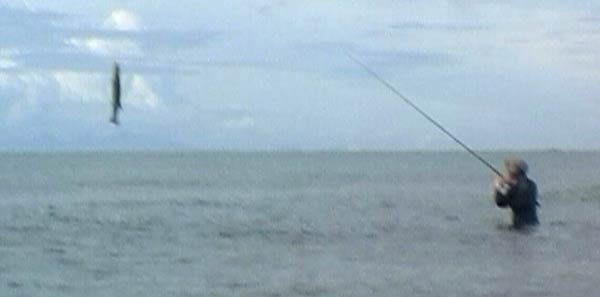
A quick P.S from work.....sorry about the quality of the barracuda picture. It's a low resolution image 'grabbed' from our latest film (still in production). This is one of several barracuda to 50lb featured in the film and obviously thought that it was a good idea to vertically leap two metres in the air.
Posted: Fri Jan 13, 2006 11:41 pm
by Stephen Hull
Steve
Thanks for all the tips - I'm rapidly running out of excuses on the poppers.
I was down at Turtle Beach today with my family (i.e. minus rod) and the pelicans and terns were very busy 100-200m offshore, as were the kingfish below. Thought I might have a go sometime. Any idea how to catch a kingfish at that distance? I have some 40g tobys in the bag but wondered whether shiny mackerel feather might work (kingfish like small lures I believe), as that would get extra distance. Locals suggest legering baitfish but I don't think I could sit still that long.
If Toine is still following this thread, did you catch kingfish from the shore or from a boat and what lures were you using?
Have a great weekend
Steve H
Posted: Sat Jan 14, 2006 1:34 pm
by Steve Pitts
Hi Steve
I think that the only reliable way to catch kingfish is from a boat. I've never seen or heard of one being caught on rod and reel from the shore. The seign netters haul them in, so they do come within 200yds of the shore.
You're in an ideal position (staying for so long) to strike a friendship with a few local fishermen at Plymouth peir. Get chatting and ask if they want to do a deal one morning - you will fish and they get to keep the fish you catch. You may have to part with a few $TT into the bargain, but generally, if you explain that you're after kingfish, they will know that this is inshore fishing (trolling between Plymouth peir and Mt Irvin), just a few hundred yards off the beach / rocks, so a nice easy morning's work for them. Kingfish seem to feed for the first 2 - 3 hours of daylight and them go off, so it isn't a whole day's fishing that you need. Ask around for 'Chicken' he's a really nice guy and will try real hard to make sure you catch, but any of the Plymouth posse are cool.
The Courland Bay and beach off of Rex Turtle is one of the best places for kingfish and Castara is another good bet. I think that they like shallow, wide, sandy bays the best.
You must use a wire trace (see article in fishing section) and I would recommend a rapala J11 or 13, or any other shallow diving plug like crystal minnow, bomber or rebel. Blue and silver always work well. A spining rod is all you need, because most kingfish will average 4 - 6lbs.
The photo at
http://www.mytobago.info/photos/fishing/kingfish.htm is a pretty good example of what to expect.
I should emphasise that I'm referring to Kingfish (like king mackerel) not Wahoo, which are also known as kingfish sometimes. Wahoo are in a different league altogether!!
Cheers
Steve
Posted: Sat Jan 14, 2006 4:56 pm
by Toine & Lia
Hi Steve, Steve, and others…
Nice thread we got going here.
December and January are the months that kingfish congregate near the beaches, according to local fisherman. They tend to travel in big groups up and down the coast. While in Tobago, I met a guy who fishes commercially for kingfish. He told me that kingfish mostly feed at night and while feeding they will come in close to the shore. In the daytime they stay together and aren’t that easy to catch on lures. Try catching them at night or early morning is his advice. These commercial guys (not the local fisherman) fish at them starting way before first light using light tackle and live bait.
I fished a few early morning sessions with Barry St. George on Alpha Lime, at the same times that guys like ‘Anaconda’ Cox and ‘Rusty’ Lewis where fishing the bay commercially.
Because of the fact that the fish were very picky and hardly showed interest in the trolled lures, we pulled a spread of five lines, all different sort of lures, on different depths and all sorts of colours.
There where really big fishes in the bay, up to 40 pound. The fact that they only were tricked by small lures explains the many fish that were lost. The hooks on these lures couldn’t stand the pressure produced by these fish. The most fish that Cox, Rusty and we could lift into the boats where between 4 and 10 pounds. All the bigger ones got away. One morning we had 21 strikes and could land only three fish. Changing hooks or bigger lures resulted in stop getting fish to strike at a lure.
Cox was very lucky a day before Christmas, he landed 22 kings. He lost that day over 20 fish. Cox, while skippering for Frankie, lost a very big king that weighed over 40 pounds. The guy, handling the rod, wasn’t experienced enough to stay calm at the time the fish appeared at the surface. The line slacked and the fish got away, just before he was gaffed.
Anaconda Cox is a master when it comes to approaching schools of kings and get a small lure in the pack of fish. Unlike most of his friends and fisherman he’s a guy who knows how to use light tackle.
Colours and size sure make a difference in catching or not. The lures that did get bites were Rapala’s magnum 14 , (mullet) grey back, white belly, Rapala’s Fat Rap Deeprunner 7 cm, again in dark colours, Berkeley Frenzy’s 11cm, again only the dark colours, Storm deep thunderstick 11 cm, black back, big eyes, white belly, Mann’s 20’s tidewater stretch, black back, white belly (these last three lures have all small hooks). We used wire trace to avoid getting bitten of. Again try wire as thin as possible. Thick wire, no bites. The thickest wire we fish on the small lures was a Rapala trace with swivels, 9 kilo test. The most bites we had on the Frenzy’s and the Mann’s.
During our stay the fish frequented between Black Rock and Plymouth and sometimes moved up and down to Culloden. We (Cox, Rusty, Barry and I) caught kings less then 200 metres in front of Rex turtle beach hotel.
If I had to try catch a king from shore, and had time enough to try doing so, I think I would go somewhere between Plymouth jetty and Black Rock before first light (very early morning). You’ll need a rod that can cover a big distance. The bottom in front of Rex turtle up to Plymouth is mostly sand, so you can use a sinker and fish a lure on a string. I ‘m pretty sure that you will definitely catch some fish. But a king….
Better get yourself aboard one of the boats of the local fisherman of Plymouth or try catch a ride aboard the boats of Cox, Rusty or Barry for an early morning session. Most likely, you’ll find these guys at Mt. Irvine Beach facilities.
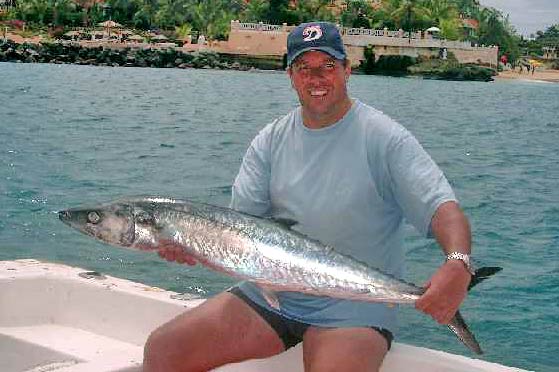
These kings are hard to catch……
Cheers.
Toine
Posted: Sun Jan 15, 2006 8:44 am
by Steve Pitts
That's one hell of a kingfish Toine!
I think that the stretch between Rex and Mt Irvin is a real hotspot for Kings and as you say, we have always caught them inshore in January / February - early mornings.
Over to you Steve.... go get 'em.
Steve
One more week
Posted: Tue Jan 17, 2006 1:42 am
by Dan
One more week until my wife and I leave cold Alaska for sunny Tobago. Our first visit to the island and we look for ward to getting a sample of all the wonderful game fish you have mentioned. Thanks for all the great fishing tips. Hopefully we will get a chance to get into a few. Steve I have emailed Kester a few times and have not heard back, if I just show up in Tobago what are the chances of getting out with him? Well again I would like to thank everyday for all there helpful advice and anyone wanting to cast a line from Jan 24-Feb let me know.
Dan
Posted: Tue Jan 17, 2006 2:27 am
by Stephen Hull
Dan
If you want to try to phone Kester he can be contacted on:
mobile - 001 868 683 1958
home 001 868 639 9961
Laurence (the initiator of this chain) and I are planning a trip out with him some time w/c 30th. He seemed free all that week when I rang him, so you should be fine for fixing a date, especially if you are here for a month.
Steve H.
Posted: Wed Jan 18, 2006 7:20 pm
by Mike Northcott

Hi All who have been following this thread. I and 4 friends are returning to Crown Point for our 4th visit in 3 years for just a short flying visit week beginning 16th Feb. We have booked Kester/Kevin for the whole week.
For those really interested in a Tarpon from the beach livebaits are the business. We have bought a cast net and learnt how to catch our own livebaits, landing them is however a very different matter.
Call in at Jimmys any evening from 16/22 til 22/2 if you are there and fancy a beer or maybe a trip out with us and Kester. We will be mixing
deep sea trolling for Marlin/FAD's and inshore for Tarpon /Bones and Permit. And or a go at the Tarpon from the beach early morning in front of Conrados, baitfish and the 'Grand Ecailles' as the locals have it, on livebaits
Mike
Kester's #
Posted: Thu Jan 19, 2006 1:57 am
by Dan
I have tried the # for Kester and can't get it to work. I cahnges the country code to 011 sice I am dialing from US, but it said it is out of order as did his cell. Any other wat to get a hold of him as he has not answered email either.
Thanks,
Dan 6 more days
Posted: Thu Jan 19, 2006 4:08 am
by C Phillips
Dan, have you tried just dialing
1 868 683 1958? Just use
1 868 followed by the other 7 digits and you should get through...? Well at least that's the way I call my family from here in the US

. I just tried that number and it rang, sooo maybe try again?
Hope this helps some?
Posted: Thu Jan 19, 2006 8:40 am
by Dan
Thanks I will try himin the am.
Dan
Posted: Thu Jan 19, 2006 6:39 pm
by Dan
Got a hold of Kester this morning. Thanks for the help.
Posted: Thu Jan 19, 2006 6:43 pm
by Steve Wooler
Hi Dan
The communication difficulties with businesses on Tobago can be/is very frustrating - but long may it remain so. The fact that commercial considerations take such a low priority with most Tobagonians is the island's very charm.
Have a great trip.
Posted: Wed Jan 25, 2006 7:11 pm
by Stephen Hull
Steve
Not been out much the last couple of weeks. Tried Sandy Point again early am - still deathly quiet there. More action at Bacolet Point - hooked and lost a couple of big jacks on shallow divers - plugs keep flying out. On hooking the fish they immediately leap 2ft out of water and crash back down - the lack of stretch in braid just seems to pull the lure straight out. Any tips? I regularly sharpen my hooks but wonder whether they just don't set well enough?
Steve H
Posted: Thu Jan 26, 2006 6:30 pm
by Steve Pitts
Steve
I - nor anyone I have fished with over the years has -
A) experienced a jack leaping either on the take or during the fight
B) ever lost more than one jack when the hooks have pulled out - once they are on, they usually stay on. They grab the lure so ferociously that you rarely have to strike. Jacks usually head for the horizon when hooked and using braid ensures a good, solid hook-up, so I'm sure it's not the braid, assuming your drag is not set too light they should hook themselves.
Your experience is, to say the least, rather odd.
Firstly - are you sure they are jacks?
Sharp hooks are essential, but if you are keeping yours sharp, then I doubt that that's the problem. You must be frustrated.
If you have any doubts about the fish being jacks, I would suggest that in order of likelihood the fish you're hooking are -
1) small tarpon (silver in colour - like a jack. Leap almost every time when first hooked . Very difficult to get a treble hook to stay in )
2) snook (leap often, hard mouths and the smaller ones are quite silvery in colour)
3) ladyfish (silver in colour, leap around a lot, small mouth so diffcult to hook)
Needle fish or barracuda both leap about, but I'm sure that you wouldn't confuse these with a jack.
If you're getting a good look at the fish and are convinced that they are jacks, then I don't know what to suggest.
Interesting problem.
Chees
Steve
Posted: Fri Jan 27, 2006 12:36 am
by Stephen Hull
Steve
I normally get a good look at them when they pop out of the water - normally only 10-20 yards away and they are big fish - 8-10lbs at least. They are quite deep bodied and large tailed. To me they look like jacks I've caught before - they could possibly be snook (which I've not caught before) although they seem deeper bodied than thep ictures I've seen. Definitely not ladyfish - I've caught plenty of those. There are tarpon at Bacolet but these don't look like them.
Speaking to Barry (one of the local fishermen), he suggested that the fish could be having difficulty getting the hooks in their mouths (although having caught some large jacks they certainly seem to have a big enough mouth to swallow most things whole). He said they often fish with single hooks or double hooks to get better hook-up rate. I will give this a try.
New lures arrived today, so I think I might go and try out one of the big poppers in the morning!
Steve